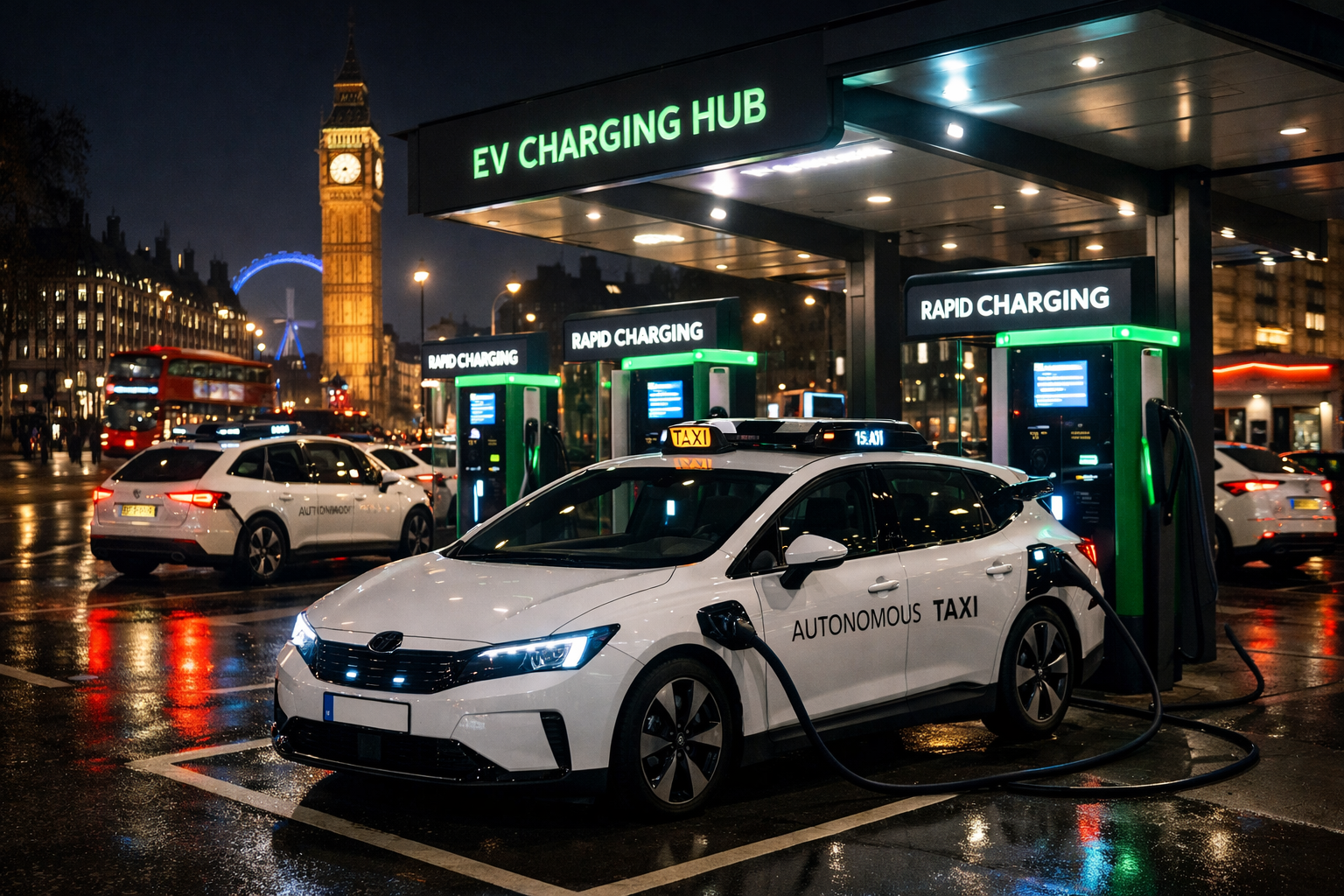
Robotaxi pilots move London from experiment to close‑in planning — practical implications for fleet and finance
Why charging matters now
The UK’s electrification of transport is undeniable, but the recent Financial Times analysis stresses a tough reality: the country needs a dramatically faster rollout of electric vehicle (EV) charge points to meet demand by 2030. The current stock of about 88 000 public chargers is significant, yet official projections suggest a need of between 250 000 and 550 000 by decade’s end. To get close to even the lower threshold requires installations roughly double what the sector delivered in 2025.
For planners, fleet managers and asset finance professionals, the charger rollout isn’t some abstract target — it’s a core infrastructure variable that silently shapes operating windows, cost assumptions and utilisation models.
Without robust, widespread charging infrastructure, the total cost of ownership for EV fleets remains uncertain and risk appetites stay constrained.
What the numbers mean for fleets
Electric vehicles are fundamentally different to combustion engine vehicles in how they interact with infrastructure. An ICE vehicle can refuel at thousands of petrol stations almost anywhere. EV's require dedicated charging, and differences in charger speed, availability and location directly affect route planning.
If you’re modelling a delivery or van fleet’s operating cost, you need clear assumptions on charger access and reliability. Having to detour for charging or facing queues at key nodes adds hours of unproductive time, which shows up in operating costs and asset utilisation. That, in turn, feeds directly into residual value forecasts and leasing terms.
The FT piece points out that rural areas like Wales and Scotland are particularly underserved. That’s exactly where many operators — municipal contractors, rural delivery firms and regional logistics hubs — are already feeling the pinch in planning there transitions.
Government pledges and industry concerns
The Department for Transport has allocated £981 million to support the national charging network, with £381 million targeted to underserved areas and £600 million to accelerate broader deployment. Those numbers matter, but only if matched by predictable policy and implementation timelines.
Industry groups have urged more enforceable targets and reduced VAT on public charging. Currently, public charging carries standard VAT, inflating user costs relative to home charging. These economic signals matter; they affect charging behaviour, investment decisions and where fleets choose to locate assets.
If the government expects vans, cars and even heavier electric trucks to hit the road at scale, it has to reduce the economic penalty of public charging and make installations predictable for investors.
Practical steps for finance teams
Asset finance professionals need to treat infrastructure as a variable, not a given. Here’s how that looks in practice:
- Stress test residuals: Build scenarios with constrained charger availability and slow rollout timelines. That improves visibility on downside risk if adoption slows or operating costs remain high.
- Adjust utilisation curves: Include dwell time at chargers as a factor in productivity models. For high‑use fleets, extended charging time shifts revenue expectations.
- Engage on policy signals: Contact local and national policymakers to stay abreast of rollout plans. Greater clarity feeds directly into more accurate pricing models.
- Consider geography: A charger distribution skewed toward urban centres changes the economics of rural and regional operations. Debt and lease terms should reflect these locational risks.
Broader implications beyond vans
The charging challenge isn’t confined to vans or passenger cars. Medium and heavy duty fleets electrifying over the next decade will be subject to the same infrastructure constraints, only magnified by higher power requirements and longer dwell times.
Even if early adopters demonstrate performance benefits, a slow public charging network will divert fleet investment toward private depot charging — a different asset class with its own financing implications. That influences working capital needs, lease structuring and the type of collateral lenders are willing to accept.
Bottom line
The UK’s charging rollout is more than a tech build. It’s a foundational piece of transport infrastructure that directly affects fleet economics, financing models and strategic planning. To hit net zero and support broader EV adoption, the country must not only install more chargers, but deliver clearer, more predictable signals on timing and scale.
For anyone involved in asset finance or operations, this issue deserves attention today, not in some distant 2030 planning session.
Source: Financial Times https://www.ft.com/content/611599ea-9e61-4366-881b-d66126f9f185
You might also like